
Skip to content
For Apple Silicon · macOS 15+

Take charge of your battery.

Ampere lives in your menu bar, watches every watt, and keeps your MacBook’s battery in the healthy zone — so it ages years slower.

brew install --cask az-code-lab/taps/ampere
Version 0.0.70 · Free to try · One‑time license, no subscription

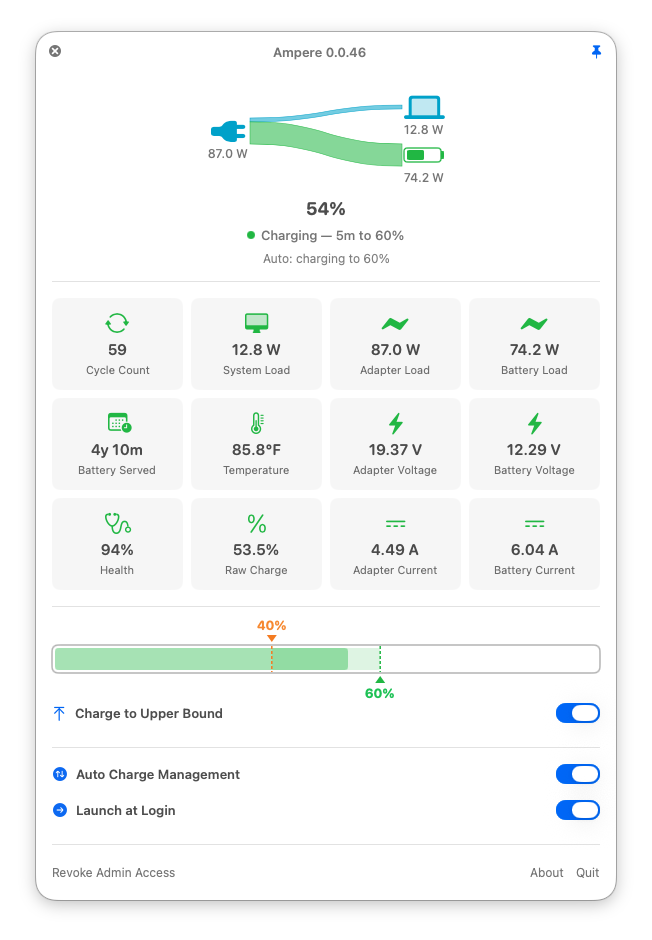
The Ampere panel showing live power flow, battery stats, and charge bounds
Charging to 70% — then holds
99% health · 17 cycles

See it in two minutes.

Charge bounds, live telemetry, and every control, narrated. Sound on.

Everything your battery
wants you to know.

And every control it wishes you had. All two clicks away, all the time.

Live power telemetry

Adapter, battery, and system wattage. Voltages, currents, temperature, cycles, health, battery age — a dozen readouts, always current.

Charge bounds

Pick a healthy range like 40–60%. Ampere charges at the bottom of it, holds in the middle, and stops at the top. Automatically.

Micro-charge prevention

No fragmented top-ups — even across restarts. Between bounds, charging stays off until you ask, so every cycle runs full: lower to upper.

Charge & discharge on demand

One toggle tops you up to the upper bound. Another actively drains down to it — even with the charger plugged in.

Survives anything

Bounds and in-progress charges resume after a relaunch. If Ampere is ever force-killed, a watchdog restores your Mac’s defaults within seconds.

Verified in-app updates

Update right from the panel. Every download is verified against the Homebrew cask’s SHA-256 and Apple’s code signature before install.

Live menu-bar icon · hover for status Sleep-safe charging Pinnable panel Launch at login Periodic health checks

Built around
the healthy zone.

Lithium-ion cells age fastest parked at 100% or drained near empty. Ampere keeps yours cruising in the band you choose — and never wastes a charge cycle getting there.

  • Below your lower boundCharging starts, and runs all the way to the top of your range — closing the lid won’t cut it short or overshoot it.
  • Between boundsAmpere holds steady. No charging until you ask — or you dip below.
  • Above your upper boundCharging stays off — or actively discharge back down, even on AC power.

Safe by design.
Reversible by default.

Ampere touches low-level charge controls, so it’s built to leave no trace. Curious how, exactly? Read the full technical details →

Quit = clean slate

Closing Ampere restores every system default — charging, sleep, everything. Crash or force-kill? A root watchdog daemon cleans up within seconds.

A helper you can trust

Charge control runs through one tiny root helper in a root-only directory, pinned to its SHA-256 digest in sudoers. A swapped or tampered binary is simply refused.

Always double-checking

Health checks continuously verify the hardware state matches what you asked for. If the charge limit drifts, Ampere writes it back, and warns you only when a repair doesn’t hold.

Open source

MIT-licensed on GitHub. Read every line that touches your machine — or build it yourself. View the source →

Up and running
in a minute.

1

Install

brew install --cask az-code-lab/taps/ampere

or download Ampere.dmg and drag it to Applications. The app and the disk image are both Developer ID signed and notarized.

2

Grant admin once

Ampere installs its charge-control helper with a single password prompt. That’s the last one you’ll see until the helper itself updates.

3

Set your bounds

Turn on auto charge, pick a range, and forget about it. Your battery takes it from here.

A license.
For your Mac.

Free to download and use for as long as you like, in the default 40 to 60% range. Buying a license unlocks custom charge bounds and supports development.

Ampere License
$…one‑time
  • Custom charge bounds: set any range you like (the free download holds 40 to 60%)
  • One key registers up to … Macs at once; swap one out whenever you like
  • Key delivered instantly on screen and by email
  • Free updates, right in the app
  • 14-day money-back guarantee
Keys
1

Keys are delivered to this address and can only be registered with it — double-check it.

Secure checkout by Stripe or PayPal · Apple Pay, Google Pay & cards

Questions, answered.

macOS already has a charge limit. Why Ampere?
The macOS limit is a ceiling only, and it only goes from 80% to 100%. A ceiling parks the battery at the limit for as long as you stay plugged in, and time spent resting at a high charge level is what ages lithium-ion fastest. Apple’s own guidance for long-term storage is around 50%, a level the built-in limit can’t reach. Ampere holds a range instead: you choose both ends of the band, say 40 to 80%. Charging stays off while the battery drifts down to the lower bound, then runs one whole pass back to the upper. The battery lives at a lower average charge, in fewer, fuller cycles, in whatever band you choose. Set it once and stop thinking about the battery.
Which Macs does Ampere support?
Apple Silicon Macs (M1 and later) running macOS 15 Sequoia or newer. On macOS 15, charge control depends on the firmware: if a security update has removed the key Ampere uses to stop a charge, Ampere monitors the battery only and says so, because macOS 15 has no charge limit to fall back on (see the technical page). macOS 14 isn’t supported, and neither are Intel Macs, which use different charge-control hardware.
Why did my battery charge to full while Ampere was holding it?
Because macOS charged it. Every few weeks while a charge limit is in use, macOS charges the battery to 100% once, to keep its state-of-charge estimate accurate, and ignores the limit until that charge is over. It happens with the built-in charge limit too, and it cannot be stopped. On firmware without the CHTE key (macOS 27), that limit is what Ampere holds with, so the hold is overridden for the duration: the status line says so, and once the battery is full it says that macOS lifts the override within about 12 hours (macOS lifts it by the clock, about 12 hours after the charge began, not when the battery fills); the health check reads suspended, and the hold resumes where the charge ends; Discharge to Upper Bound brings the battery back to the bound. See macOS’s calibration charge.
Why does it need my admin password?
Pausing and resuming charging requires writing to the SMC, which needs root. Ampere installs a minimal helper binary for exactly that, protected by a sudoers rule pinned to the helper’s SHA-256 digest — you’ll only be asked again when the helper itself changes. Other accounts on the same Mac are asked once each, because the rule keeps one line per account.
Is it safe? What happens if the app crashes?
Everything Ampere changes is reversible, and reversal doesn’t depend on the app exiting cleanly. A detached watchdog daemon monitors the app and restores normal charging, discharge, and sleep settings within seconds if Ampere ever dies unexpectedly.
How do I uninstall it?
Quit Ampere, then drag it to the Trash or run brew uninstall ampere. Quitting puts charging and sleep settings back, and two minutes later a small root cleanup job that Ampere registers removes the helper, its sudoers rule, itself, and Ampere’s preferences and caches for every account, so nothing is left behind. If you delete the app while it is still running, the job waits until that copy quits and then does the same. To do it immediately, quit Ampere and run sudo /Library/PrivilegedHelperTools/az-ampere-smc purge.
What does a license unlock?
Custom charge bounds. An unregistered copy has every other feature and holds the battery in the default 40 to 60% range; once registered, you can drag both bounds anywhere. If a registration lapses (the Mac is released from its key, say), the range goes back to the default until you register again.
Can I move my license to a new Mac?
Yes. A key registers up to … Macs at once, so a new Mac usually just registers with the same email and key beside the others. Once the key is full, another Mac is refused until you make room: deregister from the panel on a Mac you no longer use, or release a Mac that is gone under My Licenses at azcode.dev. A released Mac goes back to unregistered at its next check. My Licenses at azcode.dev and the app’s registration window show how many Macs your key is in use on, out of how many it registers.
I need licenses for several Macs.
One key already registers up to … Macs at once. For more Macs than that, or to give people their own keys, set the number of keys before checkout: you’ll get them all in a single purchase, bound to your email.
What if I lose my key?
Your keys are in the purchase email — and always available online: sign in at azcode.dev with the same email (no password needed, a login link is sent to you) and open My Licenses to see every key you own, copy it, and check which Macs it’s registered on.
What’s your refund policy?
If Ampere isn’t for you, tell us within 14 days of purchase for a full refund — sign in at azcode.dev with your purchase email and open a ticket. Refunded keys are deactivated.
Does Ampere phone home?
No analytics, no tracking. Once registered, the app re-verifies your license about once a day and whenever you open its registration window (email, device serial, app version, and macOS version), and checks the Homebrew cask for updates. An unregistered copy contacts no license server at all. Network failures never deactivate a registration. The fine print lists everything the license server keeps.

Give your battery
a longer life.